PURPOSE
The purpose of this policy is to provide protection against sexual and gender-based misconduct for each member of the Global Leadership Institute (GLI) community and the processes of response if required.
SCOPE
Whole Institute
PRINCIPLES
Prevention
GLI ensures that:
- a culture of safety and respect is fostered within the GLI community across all delivery sites and modes;
- there is no tolerance for sexual or gender-based misconduct;
- all members of the GLI community are, where it is reasonable and safe to do so, responsible for ensuring that sexual and gender-based misconduct does not occur;
- as far as is reasonably practicable, campus security is designed to prevent or minimise the risk of sexual and gender-based misconduct;
- relevant policies are explained clearly at staff induction and student orientation;
- all staff complete training regarding sexual and gender-based misconduct prevention strategies and incident responses;
- regular training is provided for First Responders;
- policies and procedures are reviewed regularly.
Reporting
GLI ensures that:
- there are safe spaces for students to raise concerns, seek help and support, and report incidents of sexual or gender-based misconduct;
- responses are sensitive to sex, gender identity, sexuality, ability, age, socio-economic status, culture, religion, or other characteristics that may affect a person’s willingness to make a disclosure or report;
- privacy and confidentiality are maintained;
- trauma-informed responses focus on the complainant’s needs, values, and preferences to minimise further harm;
- immediate action is taken after receiving a sexual or gender-based misconduct report to prevent its recurrence and address its effect;
- all staff and students who are parties to incident reports have access to relevant counselling, medical, police, or legal services;
- accessible and non-discriminatory support services are available for staff and students;
- staff or students who have experienced sexual or gender-based misconduct may choose whether they want to make a report to GLI or make an external report;
- all individuals involved are treated fairly, impartially, and with compassion and empathy, while adhering to the principles of procedural fairness in proceedings or decisions;
- the complainant has the right to anonymous or external reporting (for example the police);
- disclosures and reports are reviewed and monitored to ensure completion of actions and future risk mitigation.
DEFINITIONS
Alleged offender: person about whom a complaint of sexual or gender-based misconduct is made as part of a report.
Complainant: person who makes a disclosure or a report. A person who has experienced sexual or gender-based misconduct may refer to themselves as a complainant, discloser, victim, or survivor.
Consent: voluntary agreement through words or conduct to engage in a sexual act/s, and the continued agreement to engage in the act/s. Consent can be withdrawn at any point. Consent cannot be given if the person is under 16 years of age; is threatened with harm, extortion, or humiliation; is under the effect of drugs or alcohol; is asleep or unconscious; is incapacitated mentally or physically; or is unlawfully detained. Consent needs to be clearly given when someone is in a position of power over someone else.
Disclosure: sharing information regarding sexual or gender-based misconduct to members of GLI staff. Disclosures will be recorded without the identity of the complainant or any details that may suggest the identity of any person involved in the incident/s for the purposes of the Institute’s risk identification, assessment, and prevention strategies.
External report: report to the police and/or external agency.
Gender: social, behavioural and cultural attributes, expectations, and norms associated with being female, male, transgender or gender diverse.
Gender equity: measures to ensure fair and equitable treatment of people regardless of gender.
Gender-based misconduct: any unwelcome or demeaning behaviour by reason of the person’s gender in circumstances in which a reasonable person would have anticipated that the person harassed would be offended, humiliated or intimidated. Examples include:
- asking intrusive personal questions based on a person’s gender, including about their body or anatomy;
- making derogatory remarks about a specific person or people who identify as gender diverse;
- making inappropriate comments or jokes to a person based on their gender, including about their appearance, gestures and voice;
- asking a person to engage in degrading conduct based on their gender;
- displaying images or materials that are sexist, misogynistic or misandrist.
Gender-based violence: any form of physical or non-physical violence, harassment, abuse or threats based on gender that results in or is likely to result in harm, coercion, control, fear, or deprivation of liberty or autonomy. Violence and harm can be physical, sexual, emotional, psychological, social, cultural, spiritual, financial and technology-facilitated abuse (including image-based abuse), and stalking.
Institute Related Conduct: any conduct connected GLI, including conduct that occurs:
- during, or in connection with, any function, activity or event related to GLI (whether sanctioned by the Institute or otherwise);
- when a person is representing GLI in any capacity;
- during, or in connection with, the performance of duties for the Institute;
- using, or is facilitated by, the Information Technology (IT) resources or other equipment; or
- on, or in connection with, any property owned, leased, or occupied by GLI (or any entities it controls) or any lands or roads within the campus.
GLI community: all staff, students, prospective students, contractors, volunteers, and visitors.
Procedural fairness: requirement to ensure fairness in the investigation and adjudication of a dispute. This involves:
- Fully informing a person of any allegation/s made against them;
- Giving them the opportunity to state their case, provide an explanation, or put forward their viewpoint;
- Conducting a proper investigation of the allegations, ensuring that all parties are heard and that all relevant submissions are considered, with reasons given for any decision;
- Permitting complainants and alleged offenders to be accompanied to any meeting by a support person;
- Acting fairly, impartially, and without bias; and
- Declaring any real or potential conflict of interest.
Reasonable measures: arrangements or adjustments that may be implemented on a case-by-case basis where a disclosure or report has been made to minimise the potential for harm to any person.
Report: sharing of information regarding an incident of sexual assault or sexual harassment to the Institute for the purpose of accessing support, taking reasonable measures, and initiating further action such as an investigation.
Sexual misconduct: any unwelcome behaviour of a sexual nature including sexual assault, sexual harassment, an act of indecency, making or distributing sexually explicit photos or videos without consent, and any other non-consensual sexual conduct if a reasonable person would consider that conduct to be an invasion of their privacy, indecent or otherwise unacceptable conduct.
Sexual assault: any offence of a sexual nature committed on another person where a person is forced, coerced, or tricked into sexual acts against their will or without their consent, including when they have withdrawn their consent, or they are unable to give consent.
Sexual harassment: any unwelcome conduct of a sexual nature, where it is reasonable to expect that the other person would be offended, afraid, or humiliated. Sexual harassment can be verbal, non-verbal, written, graphic or physical. Sexual harassment includes but is not limited to:
- any deliberate and/or unsolicited sexual communication, the use of overt sexual language, suggestive or physical contact that creates an uncomfortable learning/working environment for the recipient and is made by a person who knows, or ought reasonably to know, that such action is unwelcome;
- sexual advance or solicitation made by one person to another, where the person making the advance or solicitation knows, or ought reasonably to know, that such action is unwelcome;
- reprisal, or threat of reprisal, for the rejection of a sexual solicitation or advance particularly where the reprisal is made or threatened by a person in a position to confer, grant or deny a benefit or advancement to the person;
- practical jokes of a sexual nature which cause awkwardness or embarrassment;
- displaying and/or distributing pornographic pictures or other offensive material of a sexual nature, including audio or visual images of an individual through technological devices, equipment and service;
- unwanted physical contact such as kissing, touching, patting or pinching;
- unwelcome sexual remarks, sexual jokes, intrusive sexual questions, sexual innuendoes or taunting about a person’s body, attire, sex, personal or social life;
- requests for sexual favours; and/or
- behaviour that is an offence under criminal law, such as physical assault, indecent exposure, stalking, technology facilitated image-based abuse or obscene communications.
Trained responders: people who are trained to assist staff and students to access support and reasonable measures and to make disclosures or reports of sexual or gender-based misconduct.
Trauma-informed: maintaining integrity during the investigation that minimises discomfort for the complainant, while maximising information obtained and avoiding memory contamination.
SUPPORT FOR COMPLAINANTS
Support available for GLI community member complainants includes:
- counselling through the Institute’s support services or referral to counselling services;
- assistance in making a report for internal investigation;
- assistance through the process of an investigation or misconduct process;
- assistance in making a report to the police or other external agency; and
- reasonable measures to minimise the potential for harm to any person including, but not limited to:
- class timetable changes;
- academic adjustments;
- placement reassignment;
- temporary remote learning or working arrangements; and
- workplace arrangements.
GLI strictly prohibits retaliation against complainants or other participants in a complaint resolution process. This includes, but is not limited to:
- reducing a student’s grade;
- decreasing an employee’s pay; or
- downgrading a person’s performance evaluation.
FIRST RESPONDERS
GLI’s First Responders are trained staff members who act as the first respondent for all allegations of sexual or gender-based misconduct within the GLI community. First Responders may provide:
- immediate support for the complainant, including confidential advice in a safe place on options available;
- explain where they can get further support;
- access to medical care, with their agreement;
- advice and referrals for ongoing safety and wellbeing needs;
- mitigate any potential ongoing risks and assist them to make a report if that is what they decide to do;
- preservation of evidence, with their agreement;
- referrals to GLI against sexual or gender-based misconduct, with their agreement;
- information about their formal reporting options.
SEXUAL AND GENDER-BASED MISCONDUCT TASKFORCE
The Sexual and Gender-Based Misconduct Taskforce is a subcommittee of Executive Management Team. Membership and terms of reference are detailed in the Executive Management Team Terms of Reference Policy.
PROCEDURES
1. Disclosure
A disclosure of sexual and/or gender-based misconduct can be made by any member of the GLI community. The complainant is encouraged to seek support from a trusted person, such as a family member, counsellor, GLI First Responder, or external provider before taking any formal action. The complainant is advised to limit the number of people they inform about the incident/s to maintain impartiality in any further investigation.
Staff who receive a disclosure from a student will refer the complainant to a GLI First Responder. The First Responder will outline options available to the complainant, such as formal reporting to the Institute, seeking community support, or reporting the police or other external agency, and referring international students to support agencies. The Institute recognises that complainants approach disclosure in different ways, so First Responders ensure maximum flexibility and care while guiding a complainant through this procedure. If the complainant chooses to take formal action, the following procedures are in place.
2. Support and/or Report
A complainant may report an incident of sexual and/or gender-based misconduct by submitting the Sexual and Gender-Based Misconduct Report Form or emailing studentsafety@gli.edu.au. If the complainant gives permission for the First Responder to release their name and contact details, the complainant and First Responder will make a report together using the report form as soon as practicable. If the complainant does not give permission for the First Responder to release their name and contact details, the First Responder will complete a de-identified recorded disclosure form and send the completed form to the Registrar as soon as practicable.
Staff members are required to make a mandatory report to the police or relative agency in relation to disclosures and reports of sexual assault, sexual harassment, and/or gender-based violence which have occurred where the complainant is aged under 18.
The opportunities for the Institute to provide support may be limited if a disclosure is made anonymously or without sufficient information. Where this applies, GLI may still use the de-identified recorded disclosure form for the purposes of the Institute’s risk identification, assessment, and prevention strategies.
Members of the GLI community may make an external report to the police or other external agency at any time and will be supported by GLI if they wish to do so. Nobody may prevent any person from reporting or referring a matter to the police or other external agency and nobody should seek to exert any pressure on any person to dissuade them from making an external report.
Past students who report an incident of sexual and/or gender-based misconduct which occurred when they were a GLI student are provided with information and referred to support services by the Institute. Past students should be aware that GLI may be limited in any investigative actions it can take.
3. Investigation
A report of sexual and/or gender-based misconduct is added to the Institute’s Complaints Register and is investigated by the Sexual and Gender-Based Misconduct Task Force. If the complainant provides contact information, the complainant is contacted within two (2) business days and, in urgent circumstances, will be contacted immediately.
GLI ensures that all parties involved are treated with respect, and are heard with compassion, without judgement or blame. Support and reasonable measures are made available to all parties to the report, as required for the duration of the process. A report of sexual and/or gender-based misconduct is not linked with other GLI systems and does not impact on the complainant’s academic standing or immigration status (for international students).
The confidentiality of all parties is respected, and reports and disclosures will not be referred to police or other external agency without the consent of the complainant, except to the extent that the staff member may be compelled to disclose details under legislation or, to protect any person from risk to life, health, or safety, or where a student is under 18 years of age. Information received as part of a report or disclosure will be accessible by the person who provided the information and kept separate from the enrolment, employment and other educational records of the complainant, or any witness.
GLI’s internal processes are for the purpose of determining sexual and/or gender-based misconduct and separate from any criminal proceedings or investigations conducted by the police or other external agency because of an external report. An internal investigation may cease whilst a police or external investigation is being undertaken.
During an investigation the Sexual and Gender-Based Misconduct Task Force may (but are not limited to) allow the complainant to accompany, but not to represent, one other person at the meeting. The complainant or First Responder may produce evidence, including witnesses. The Task Force must:
- ensure care and consideration for a person’s wellbeing
- avoid the potential of any additional trauma or harm to all individuals involved;
- ensure required support is provided;
- ensure confidentiality of disclosures;
- act fairly and respectfully, treating all involved with dignity;
- listen with compassion, not judgement or blame;
- ensure that the rights and responsibilities of all parties involved are protected;
- ensure de-identified data on disclosures and formal reports.
Support is also available via publicly accessible services such as National Sexual, Domestic and Family Violence Counselling Service (1800 RESPECT) on 1800 737 732 (24 hours a day/7 days a week).
4. Decision
After the investigation is complete, the Sexual and Gender-Based Misconduct Task Force may either:
- reject the complaint if it lacks substance;
- report the sexual and/or gender-based misconduct to relevant authorities both internal and external to GLI if the complaint has supporting evidence.
The Chair of the is responsible for completing the final report. This includes de-identified details on the misconduct, actions taken, and outcomes of the investigation. All investigations are reported to Executive Management Team. An annual report is submitted to Governing Board.
5. Response
Responses to the Sexual and Gender-Based Misconduct Task Force decision are determined on a case-by-case basis. In implementing a response, GLI will:
- consider risk to the complainant;
- apply the principles of procedural fairness;
- seek to balance any conflicting rights and interests and ensure victimisation does not occur;
- consider any requirements potentially amounting to a criminal offence; and
- discuss the proposed reasonable measures with the affected parties.
Where the alleged offender is a student, Executive Management Team may apply one or more penalties in accordance with the Code of Conduct Policy.
6. Record
All reports of sexual and/or gender-based misconduct, records, and correspondence taken, including those made to and/or in connection with GLI owned or affiliated student accommodation are securely retained in accordance with the Information and Record Management Policy. For the purposes of reporting sexual and/or gender-based misconduct, information received as part of a report is recorded by, monitored, and reported upon by GLI.
Subject to confidentiality requirements, all parties involved are allowed reasonable access to recorded information about themselves. Access to other information relating to a report of sexual and/or gender-based misconduct are restricted to LI staff who have a need to access and use the information to carry out their responsibilities under this procedure.
INCIDENTS OUTSIDE GLI
Where staff or students disclose incidents that occurred outside the domain of GLI, such as in their home or an external workplace, a First Responder may recommend available support services, and support them if they wish to report incident/s to the police.
GLI does not investigate allegations of sexual and/or gender-based misconduct made against people who are not part of the GLI community, or incidents not connected to the Institute. However, the Institute provides support and information for students who disclose or report sexual and/or gender-based misconduct and will support them if they wish to report their experience to the appropriate authority.
APPEAL
Any complaints regarding procedures undertaken by GLI should follow the Student Grievance and Appeals Policy.
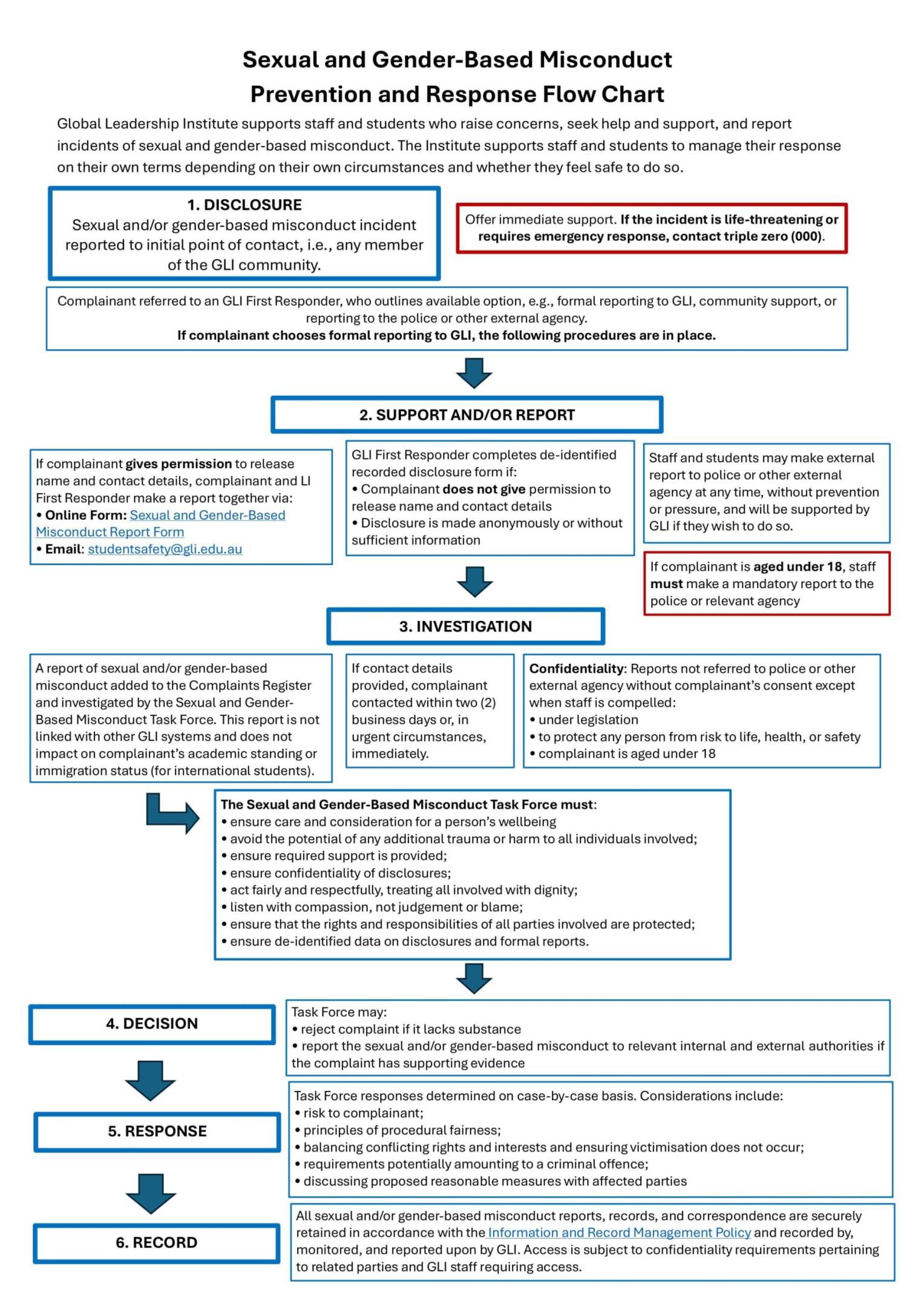
Sexual and Gender-Based Misconduct Reporting Flow Chart
GLI supports staff and students who raise concerns, seek help and support, and report incidents of sexual and/or gender-based misconduct. GLI supports staff and students affected by sexual assault, sexual harassment, and/or gender-based violence to manage their response on their own terms depending on their own circumstances and whether they feel safe to do so.
Sexual and Gender-Based Misconduct
Prevention and Response Flow Chart
Global Leadership Institute supports staff and students who raise concerns, seek help and support, and report incidents of sexual and gender-based misconduct. The Institute supports staff and students to manage their response on their own terms depending on their own circumstances and whether they feel safe to do so.