Amazing Opportunities

for everyone

short linksApply Now

Responsible Conduct of Research Policy

PURPOSE

This policy details the principles and processes for responsible conduct of research at Global Leadership Institute (GLI) by academic staff and Higher Degree Research (HDR) students. It is based on the Australian Code for the Responsible Conduct of Research (2018) (National Code) and associated guides.

SCOPE

All academic staff and HDR students

Matters relating to coursework Masters capstone projects are dealt with according to the Academic Integrity Policy

PRINCIPLES

In accordance with the National Code, GLI’s principles of responsible conduct of research are:

  1. Honesty in the development, undertaking, and reporting of research.
  2. Rigour in the development, undertaking, and reporting of research.
  3. Transparency in declaring interests and reporting research methods, data, and findings.
  4. Fairness in the treatment of others.
  5. Respect for research participants, the wider community, animals, and the environment.
  6. Recognition of the right of First Nations Peoples to engage in research that affects or is of significance to them.
  7. Accountability for the development, undertaking, and reporting of research.
  8. Promotion of responsible research practices.

DEFINITIONS

Allegation: claim or assertion arising from preliminary assessment that there are reasonable grounds to believe a breach has occurred. may refer to a single allegation or multiple allegations.

Balance of Probabilities: on the weight of evidence, it is more probable than not that a breach has occurred.

Breach: failure to adhere to the National Code, relevant legislation, and GLI policies. It may refer to a single breach or multiple breaches.

Complainant: person who lodges a complaint regarding a potential breach of responsible research conduct.

Conflict of Interest: independent observer may reasonably conclude that professional actions of a person or institution are or may be unduly influenced by other interests;

Delegated Officer: designated GLI academic leader with knowledge of research practice, legislation, and policies.

Research: see Research and Scholarship Policy

Researcher: academic staff member (including contracted HDR supervisors) or HDR student engaged in research activity.

Research Data: facts, observations, or experiences on which an argument, theory, hypothesis, or test is based. It includes raw or analysed information, such as notes, digital or hard copy primary sources, questionnaires, multimedia outputs, photographs, artefacts, or tests.

Respondent: person being investigated regarding a potential breach of responsible research conduct.

RESPONSIBILITIES OF GLI

GLI ensures that:

  • responsible research conduct is mandated and monitored;
  • this policy is clearly explained during staff induction, HDR supervisor training, and HDR student induction;
  • regular training and resources about the National Code are provided for academic staff, HDR supervisors, and HDR students;
  • governance and management practices of responsible research conduct are maintained;
  • dissemination of research findings is encouraged, facilitated, and supported;
  • processes are in place to report and investigate complaints about potential breaches of the National Code;
  • resolution of complaints is prompt, effective, and fair with a focus on the welfare of all parties involved;
  • safe and secure storage of research data is provided, and appropriate access managed;
  • no victimisation of complainants or respondents is tolerated.

RESPONSIBILITIES OF RESEARCHERS

GLI researchers have a responsibility to:

  • support a culture of responsible research conduct;
  • undertake regular training in responsible research practices;
  • obtain all approvals prior to commencement of research and adhere to any conditions of approval;
  • adhere to the National Statement on Ethical Conduct in Human Research and the National Code;
  • comply with relevant legislation, discipline standards, and GLI polices;
  • present information truthfully and accurately in proposing, conducting, and reporting research;
  • cite other relevant work appropriately and accurately;
  • participate in peer review that is fair, rigorous, and timely, maintaining confidentiality where required;
  • demonstrate robust methodology appropriate to research aims and conclusions that are justified by results;
  • share and communicate methods, data, and findings openly, responsibly, and accurately;
  • disclose and manage actual or perceived conflicts of interest;
  • acknowledge those who have contributed to the research, giving credit or authorship where appropriate;
  • value and engage with First Nations Peoples communities prior to commencement of the research and adhere to the Ethical Guidelines for Research with Aboriginal or Torres Strait Islander Peoples.

MANAGEMENT OF DATA AND PRIMARY MATERIALS

Management of research data and primary material during and after research is finalised adheres to Information and Record Management Policy. Subject to any confidentiality, contractual, privacy or protection requirements, access and reference to research data and materials must be permitted.

COLLABORATIVE RESEARCH

GLI encourages collaboration between researchers, institutions, and industry where the research is appropriately managed through a Memorandum of Understanding (MOU). All researchers must comply with the National Code, relevant legislation, and GLI policies, in addition to any other relevant standards from the collaborator.

BREACHES OF RESPONSIBLE RESEARCH CONDUCT

Breaches of responsible research conduct at GLI include, but are not limited to:

  1. Not meeting required research standards:
    • failure to adhere to the Research Ethics Policy;
    • failure to conduct and report research as approved by GLI’s external authorised human research ethics body;
    • conducting research without the requisite approvals;
    • misuse of research funds;
    • concealment or facilitation of breaches (or potential breaches) of the National Code by others, such as not reporting potential breaches and/or facilitation of breaches.
  2. Fabrication, falsification, misrepresentation:
    • fabrication or falsification of research data, software codes, or source material;
    • misrepresentation of research data or source material;
    • falsification and/or misrepresentation to obtain funding.
  3. Plagiarism:
    • plagiarism of another’s work, including theories, concepts, research data and source material;
    • duplicating a publication without acknowledgment of the source, including self-plagiarising;
    • deception in proposing, carrying out, or reporting results of research.
  4. Research data management:
    • failure to appropriately maintain research data and primary materials as detailed in the Information and Record Management Policy;
    • inappropriate destruction of research records, research data, and/or source material;
    • inappropriate disclosure of, or access to, research records, research data and/or source material.
  5. Supervision:
    • failure to provide adequate guidance or mentorship on responsible research conduct to researchers, research trainees or research students under their supervision;
    • failure to ensure that supervisors meet eligibility criteria;
    • failure to act in accordance with the Research Supervision Policy.
  6. Authorship:
    • failure to acknowledge the contributions of others fairly;
    • misleading ascription of authorship including failing to offer authorship to those who qualify or awarding authorship to those who do not meet the requirements.
    • failure to adhere to the authorship requirements in the Research and Scholarship Policy.
  7. Conflicts of interest:
    • failure to disclose and manage actual, potential, or perceived conflicts of interest;
    • failure to declare relevant interests to funding bodies, research participants, publishing editors, collaborators, and the general public;
    • failure to declare financial interests related to a member of the researcher’s immediate family.
  8. Peer review:
    • failure to participate in peer review in a fair and responsible way;
    • failure to maintain confidentiality or use information obtained for personal advantage;
    • failure to act appropriately, respectfully, and constructively when conducting a peer review.
  9. Collaboration:
    • failure to adhere to the protocols listed in a GLI MOU;
    • failure of collaborators to comply with the National Code, relevant Australian legislation, and GLI policies;
    • failure to comply with relevant policies and legislation of international collaborators;

Where a complaint relates to activities that have (or have the potential to) harm humans, animals, or the environment, GLI takes immediate action to minimise the risk of harm. In such cases, it may also be necessary to inform relevant external agencies and/or manage the matter in accordance with relevant GLI policies. Where a breach involves potentially corrupt or criminal behaviour, the matter may be referred to an external agency to investigate.

SEVERITY OF BREACHES

Severity of a breach of responsible research conduct is determined on a case-by-case basis and considers:

  • extent of the breach;
  • extent to which research participants, the broader community, animals, and the environment are or may have been affected by the breach;
  • extent to which the breach impacts the credibility of research;
  • whether the breach is a significant departure from accepted practice;
  • level of experience of the researcher;
  • whether GLI failed to provide adequate training for academic staff and/or HDR students;
  • whether there is a pattern of breaches by the researcher;
  • any other mitigating or aggravating circumstances that occurred.

Minor

Honest differences in judgement and unintentional errors that can be addressed at the preliminary assessment stage. This generally includes:

  • a requirement for the respondent to receive counselling or mentoring;
  • an informal warning;
  • a formal warning recorded on the student’s record if applicable.

Major

This generally includes:

  • intentional, reckless, and/or negligent breach of responsible research conduct; and/or
  • repeated or persistent breaches after previous corrective actions or as requested by GLI’s external authorised human research ethics body.

Major breaches require investigation.

PROCEDURES

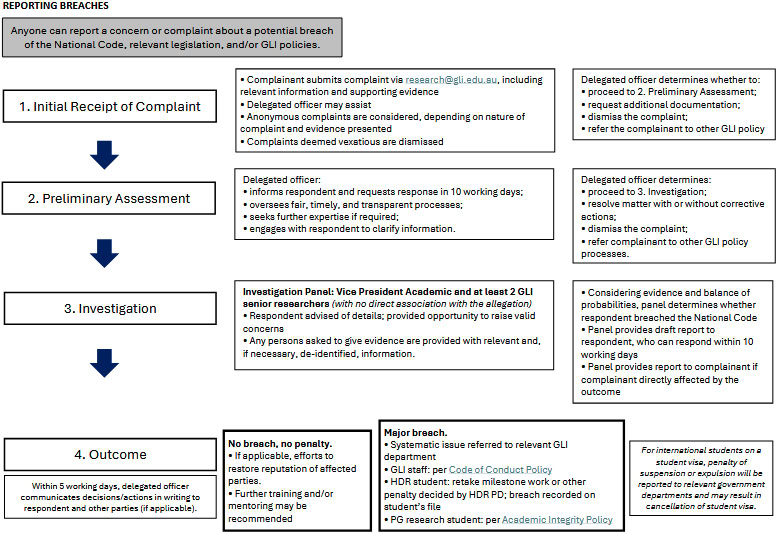
BREACHES OF RESPONSIBLE RESEARCH CONDUCT FLOWCHART
REPORTING BREACHES

Anyone can report a complaint about a potential breach of responsible research conduct. GLI academic staff have an obligation to report suspected breaches. The complainant may:

  • communicate directly with the person against whom the complaint is made;
  • refer the matter to a person in a supervisory capacity;
  • not proceed with a complaint considering the circumstances;
  • submit a complaint.
  1. Initial Receipt of Complaint

The complainant submits a complaint via research@gli.edu.au, including relevant information and supporting evidence. The delegated officer may assist a complainant in submitting a complaint. Anonymous complaints are considered, depending on the nature of the complaint and the evidence presented. Complaints deemed vexatious are dismissed. Where a complainant subsequently chooses not to proceed with a complaint, GLI is still obliged to determine whether to proceed to a preliminary assessment.

Upon receipt of a complaint, the delegated officer determines whether to:

  • proceed to a preliminary assessment;
  • request additional documentation;
  • dismiss the complaint;
  • refer the complaint to other GLI policy processes.

Potential breaches in collaborative research are managed on a case-by-case basis, depending on the lead institution, contractual arrangements, where the events occurred, where the complaint was lodged, and relevant international research practices.

  1. Preliminary Assessment

If the complaint proceeds to a preliminary assessment, the delegated officer:

  • informs the respondent and requests a response in writing within 10 working days;
  • oversees fair, timely, and transparent processes;
  • seeks further expertise if required;
  • engages with the respondent to clarify information.

The delegated officer then determines whether to:

  • proceed to investigation;
  • resolve the matter with or without corrective actions;
  • dismiss the complaint;
  • refer the complaint to other GLI policy processes.

Outcomes of the preliminary assessment are provided to the complainant and respondent at the conclusion of a preliminary assessment, if appropriate.

  1. Investigation

For a major breach, an Investigation Panel is constituted, including the Academic Dean and at least two GLI researchers in a relevant field who have no direct association with the allegation. The respondent is advised of the investigation, in writing, and provided an opportunity to meet with the panel and bring a support person.

Considering the evidence and on the balance of probabilities, the panel determines whether the respondent has breached responsible research conduct. The panel provides a draft report to the respondent who can respond within 10 working days. The report is also to be provided to the complainant in cases where the complainant is directly affected by the outcome.

  1. Outcome

Within five (5) working days after the panel meeting, the delegated officer communicates the decision to the respondent in writing. If applicable, other parties are also informed of the decision.

If the panel decides that the respondent did not breach responsible research conduct, no penalty is applied. Efforts, if required, are made to restore the reputation of affected parties. Where there is a finding of poor scholarship, the delegated officer may recommend further training and/or mentoring.

A major breach of responsible research conduct may result in the following:

  • a systematic issue at GLI is referred to the relevant department to be addressed;
  • an academic staff member is dealt with according to the Code of Conduct Policy;
  • a HDR student may be required to retake milestone work or other penalties decided by the HDR Program Director. The breach is recorded on the student’s file.

INTERNATIONAL STUDENTS

For international students on a student visa, a penalty of suspension or exclusion will result in being reported to the relevant government departments and may result in cancellation of the student visa.

GLI makes every effort to correct any public records of the research, including publications, if a breach has affected the accuracy or trustworthiness of research findings and their dissemination.

COMPLAINTS, GRIEVANCES, AND APPEALS

If a HDR student wishes to appeal the decision, they have the right to follow the Student Grievance and Appeals Policy. The student should provide as much detail as possible in support of their case, including drafts of the work in question.

RESPONSES TO STAFF BREACHES

If the academic staff member wishes to appeal the decision, the Staff Grievance Policy should be followed. Penalties for research misconduct will consider the fact that academic staff are expected to have learned responsible research conduct earlier during their research journey. Breaches may result in disciplinary action listed in the Code of Conduct Policy.

Close

Associate Professor Jason Hartley

Jason Hartley is lecturer in criminology at Griffith University in Brisbane, Australia. He is a former police officer with 23 years of experience, and has trained personnel for deployment in Timor Leste, the Solomon Islands, Iraq and Afghanistan. Jason specializes in, and has published on engagement with Muslim communities, Indigenous Polynesian approaches to rehabilitation and reducing recidivism, and Asian Organised Crime. Jason also completed a community internship in Hebron on the West Bank.

Close

Professor Grant Pitman

Professor Grant Pitman is the president of the Global Leadership Institute. He has held senior leadership roles in government such as Chief Superintendent of Police and Director of Strategic Planning ICT in the Queensland Police Service;

  • Varied list of contributions to law enforcement, including disaster management, auditing and finance, organizational reform, education and human resources, and policy development
  • National, state, and regional levels of professional service, including the Ipswich Economic Forum, the Brisbane Airport Emergency Planning Committee, the National Emergency Communications Working Group, the National Police Drug and Alcohol Task Force, and the Police Education Advisory Council.

He has a Ph.D. and Master of Administration from Griffith University. He is a well-versed researcher and has published numerous articles and journals.

Close

Professor Kevin Tickle

Professor Kevin Tickle has extensive experience in Executive Management roles in the tertiary education sector, both public and private, over the last two decades and has been a consultant to Higher Education providers in Australia and overseas. His primary areas of interest are Leadership, Management, Information Technology, Mathematics and Statistics with expertise in the areas of probability modelling; decision support, and data analytics. He is currently a Fellow of the Australian Institute of Management, a member of the Institution of Engineers, Australia, the Australian Computer Society and an Emeritus Professor at CQUniversity.

Close

Mr Des Lacy OAM

Des serves as Secretary/Treasurer of the Asia Pacific Chapter of FBI National Academy Associates, after completing 40 years in the Queensland Police Service. During his distinguished career, Des was District Officer (A/Chief Superintendent) in Charge of the Gold Coast Police District, Police Commander for the Gold Coast Indy, Super V8s, Gold Coast Marathon, and Schoolies, as well as National Rugby League and Australian Foot League events in Brisbane and the Gold Coast. Des oversaw development and implementation of the Integrated Justice Information Systems, Integrated Traffic Policing Program, and Integrated Tasking and Analysis System. He served as Director of the Strategic Services Branch and Information and Communications Technology Command, as well as Chair of the District Disaster Management Group and Security Operations Coordinator for the 2018 Commonwealth Games. 

Des has been a member of Rotary International for 30 years, representing Rotary International in the United States and the Middle East. For his work in the Gold Coast Community Des was awarded Citizen of the Year at the 2013 Gold Coast Australia Day celebrations. Des also was one of the founding Directors for the Oxenford and Coomera Community Youth Centre that provides much needed social services to the Northern Gold Coast Community. For the past 15 years, he has also been the Chair of this not-for-profit establishment. It. For his work promoting International Law Enforcement Des was awarded the Order of Australia Medal in 2017.

Qualifications

Graduate Diploma of Management

Graduate Certificate Business Management 

Bachelor of Business

Close

Dr Shantanu Banerjee

Dr Shantanu Banerjee is senior lecturer at Leaders Institute. With extensive experience in management, leadership, and administration across a range of contexts in India and Australia, Dr Banerjee is also currently an Industry Fellow at the University of Queensland Business School. His research focuses on socio-cultural-political contexts, particularly in the field of agribusiness and international business. His research has highlighted variations in the theme of international competitiveness by emphasising non-economic and non-market variables and on how multinational enterprises subsidiaries can pursue legitimacy pursuing non-market strategies. 

Dr Banerjee has presented his research work at esteemed international conferences such as ANZIBA and EIA and has published in scholarly journals including International Business Review and Management International Review. He graduated from the Institute of Foreign Trade, New Delhi (India) and the University of Queensland Business School. He has been an academic staff member at the University of Queensland and Queensland University of Technology, lecturing in undergraduate and postgraduate programs. Dr Banerjee has over 15 years of extensive and varied experience as an International Business Manager dealing and negotiating with overseas clients based in the United States of America, China, Japan, Canada, Switzerland, and Germany. He is currently employed with a Federal agency of the Australian Treasury. 

Qualifications

Doctor of Philosophy, University of Queensland, 2012

Master of Research, Queensland University of Technology, 2005

Master of Business, Queensland University of Technology, 2003

Postgraduate Diploma in International Trade, Indian Institute of Foreign Trade, 1986

Bachelor of Mechanical Engineering

Indian Institute of Foreign Trade, 1985


Communities of Practice

  • Editorial Board, Academy of International Business
  • Editorial Board, European Academy of Management
  • Editorial Board, Leadership & Management Studies in Sub-Sahara Africa Conference
  • Editorial Board, International Journal of Entrepreneurship and Small Business
Close

Associate Professor Ben Arachi

BIOGRAPHY

Associate Professor Ben Arachi has four decades (1977-2023) of experience in higher education leadership and teaching. During his 15 years as Unit Coordinator at Central Queensland University, he received two Excellence in Teaching Awards and was nominated for the Vice-Chancellor’s Award for Outstanding Contributions to Learning and Teaching and the Australian Awards for University Teaching. His online learning study was published in Economics for Today (Cengage 2022).

Previously, Associate Professor Arachi  served as Vice Principal, Head of the Department of Extension and Research, and Editor-in-Chief of the academic journal at Arul Anandar College, India (1992-1997). He was then Research Coordinator and Course Coordinator (1999-2008), as well as Chair of the Division of Economics (2000-2005) at HELP University, Malaysia. This included senior involvement in the application to become a University College and then a full University.

Associate Professor Arachi also has over 20 years of experience as a higher degree research supervisor, moderator, and examiner for doctoral degrees. In his five years as a Coordinator of All India Christian Higher Education, he organised numerous state-level seminars and workshops for academics in higher education in India. He has published four monographs, many research papers and articles while editing the Research AAC Journal of Economics. He has reviewed many higher education textbooks.

QUALIFICATIONS

  • Doctor of Philosophy, Madursi Kamaraj University, India, 1989

  • Master of Arts, University of Madras, 1975 (Gold Medalist)

  • Bachelor of Arts, Madursi Kamaraj University, India, 1973 (University Rank and Merit Scholarship)

  • Diploma in Applied Economics, Madursi Kamaraj University, India, 1980

ACADEMIC LEADERSHIP

  • Member, Academic Board, 2023-current

  • Chair, Examiners Committe, 2023-current

  • Member, Course Advisory Committee, 2022-current

AWARDS

  • Central Queensland University Student Voice Commendation. The 2021 program includes unit evaluation data from term 3, 2020 and terms 1 and 2, 2021.

  • Central Queensland University  Student Voice Commendation. The 2020 program includes unit evaluation data from term 3, 2019 and terms 1 and 2, 2020.

  • Central Queensland University Central Queensland University Platinum certificate Top rated Unit in Term 2, 2019

  • Central Queensland University Gold certificate Highly rated Unit in Term 2,2019 (ACCT20070)

  • Gold certificate Highly rated Unit in Term 2,2019 from CQU(ECON11026)

  • Charles Sturt University Excellence in Teaching Award (ECO511)

Close

Dr Bandula Nambukara-Gamage

Dr Bandula Nambukara-Gamage is a Senior Lecturer of Accounting and Finance at James Cook University, Brisbane campus. He currently teaches Bachelor of Commerce, Bachelor of Accounting, Master of Professional Accounting, and Master of Business Administration students based on the Brisbane campus. Dr Nambukara-Gamage has previously lectured at Central Queensland University, Federation University, and Charles Darwin University.

QUALIFICATIONS

Doctor of Philosophy, University of New England, 2013

Master of Commerce

Licentiate Certificate (recognised by the Institute of Chartered Accountants of Australia)

Bachelor of Business Administration (Honours)

Close

Professor Rod St Hill

Professor Rodney St Hill is the former President of Leaders Institute (2018-2020) and serves as Senior Pastor (2016-current) at IgniteLife Church Gold Coast, where he heads IgniteLife Business, an outreach to Christians in business. He is a leader in the global Business As Mission movement. He also consults on governance and executive management in higher education and business, with a particular special interest in Christian education institutions and businesses.

Previously, Professor St Hill was a long-term senior leader and Vice President Academic of Christian Heritage College, Brisbane. With the input of his colleagues and many others in his network, he developed business curriculum that embeds the ‘5 P missional business’ model – a model of production, people, planet, and profit. He was also Dean of Students, among other roles, at University of Southern Queensland (1993-2009).

QUALIFICATIONS

Doctor of Philosophy, University of Cantebury, 1989

Bachelor of Commerce (Hons 1), University of Newcastle, 1979

EXTERNAL EXPERT REVIEWER

External Member, various course assessment panels in business, management and leadership at Alphacrucis College, Australian College of Divinity, and Avondale University College, 2014 to 2020

Member: Australian Institute of Company Directors

COMMUNITIES OF PRACTICE

Member: Economic Society of Australia

External Expert, Tertiary Education Quality and Standards Agency (TEQSA), 2019-current

Close

Ps Duane Van Vuuren

Ps Duane Van Vuuren has served as Brisbane Campus Director, Postgraduate Leadership Studies Director, Unit Coordinator, and Lecturer at Alphacrucis University College. He also served as Executive Pastor at several churches across Australia.

Qualifications
Doctor of Philosophy in Leaders – candidate
Master of Arts
Master of Leadership
Graduate Certificate of Leadership

Close
Geoff Sheldon

Associate Professor Geoff Sheldon

Associate Professor Geoff Sheldon is a part-time Doctoral and Masters theses examiner for University of Southern Queensland and has been a visiting professor and guest lecturer at Bond University. He is the holder of a Doctorate of Policing and Security and a Master of Leadership, together with five other post and under-graduate qualifications. His distinguished Queensland policing career saw him serve across the entire state for just over 42 years (1982-2023), most recently in the Gold Coast and Cairns Districts at the level of Superintendent. He serves on multiple boards and charity committees.

Close

Responsible Conduct of Research Policy

PURPOSE

This policy details the principles and processes for responsible conduct of research at Global Leadership Institute (GLI) by academic staff and Higher Degree Research (HDR) students. It is based on the Australian Code for the Responsible Conduct of Research (2018) (National Code) and associated guides.

SCOPE

All academic staff and HDR students

Matters relating to coursework Masters capstone projects are dealt with according to the Academic Integrity Policy

PRINCIPLES

In accordance with the National Code, GLI’s principles of responsible conduct of research are:

  1. Honesty in the development, undertaking, and reporting of research.
  2. Rigour in the development, undertaking, and reporting of research.
  3. Transparency in declaring interests and reporting research methods, data, and findings.
  4. Fairness in the treatment of others.
  5. Respect for research participants, the wider community, animals, and the environment.
  6. Recognition of the right of First Nations Peoples to engage in research that affects or is of significance to them.
  7. Accountability for the development, undertaking, and reporting of research.
  8. Promotion of responsible research practices.

DEFINITIONS

Allegation: claim or assertion arising from preliminary assessment that there are reasonable grounds to believe a breach has occurred. may refer to a single allegation or multiple allegations.

Balance of Probabilities: on the weight of evidence, it is more probable than not that a breach has occurred.

Breach: failure to adhere to the National Code, relevant legislation, and GLI policies. It may refer to a single breach or multiple breaches.

Complainant: person who lodges a complaint regarding a potential breach of responsible research conduct.

Conflict of Interest: independent observer may reasonably conclude that professional actions of a person or institution are or may be unduly influenced by other interests;

Delegated Officer: designated GLI academic leader with knowledge of research practice, legislation, and policies.

Research: see Research and Scholarship Policy

Researcher: academic staff member (including contracted HDR supervisors) or HDR student engaged in research activity.

Research Data: facts, observations, or experiences on which an argument, theory, hypothesis, or test is based. It includes raw or analysed information, such as notes, digital or hard copy primary sources, questionnaires, multimedia outputs, photographs, artefacts, or tests.

Respondent: person being investigated regarding a potential breach of responsible research conduct.

RESPONSIBILITIES OF GLI

GLI ensures that:

  • responsible research conduct is mandated and monitored;
  • this policy is clearly explained during staff induction, HDR supervisor training, and HDR student induction;
  • regular training and resources about the National Code are provided for academic staff, HDR supervisors, and HDR students;
  • governance and management practices of responsible research conduct are maintained;
  • dissemination of research findings is encouraged, facilitated, and supported;
  • processes are in place to report and investigate complaints about potential breaches of the National Code;
  • resolution of complaints is prompt, effective, and fair with a focus on the welfare of all parties involved;
  • safe and secure storage of research data is provided, and appropriate access managed;
  • no victimisation of complainants or respondents is tolerated.

RESPONSIBILITIES OF RESEARCHERS

GLI researchers have a responsibility to:

  • support a culture of responsible research conduct;
  • undertake regular training in responsible research practices;
  • obtain all approvals prior to commencement of research and adhere to any conditions of approval;
  • adhere to the National Statement on Ethical Conduct in Human Research and the National Code;
  • comply with relevant legislation, discipline standards, and GLI polices;
  • present information truthfully and accurately in proposing, conducting, and reporting research;
  • cite other relevant work appropriately and accurately;
  • participate in peer review that is fair, rigorous, and timely, maintaining confidentiality where required;
  • demonstrate robust methodology appropriate to research aims and conclusions that are justified by results;
  • share and communicate methods, data, and findings openly, responsibly, and accurately;
  • disclose and manage actual or perceived conflicts of interest;
  • acknowledge those who have contributed to the research, giving credit or authorship where appropriate;
  • value and engage with First Nations Peoples communities prior to commencement of the research and adhere to the Ethical Guidelines for Research with Aboriginal or Torres Strait Islander Peoples.

MANAGEMENT OF DATA AND PRIMARY MATERIALS

Management of research data and primary material during and after research is finalised adheres to Information and Record Management Policy. Subject to any confidentiality, contractual, privacy or protection requirements, access and reference to research data and materials must be permitted.

COLLABORATIVE RESEARCH

GLI encourages collaboration between researchers, institutions, and industry where the research is appropriately managed through a Memorandum of Understanding (MOU). All researchers must comply with the National Code, relevant legislation, and GLI policies, in addition to any other relevant standards from the collaborator.

BREACHES OF RESPONSIBLE RESEARCH CONDUCT

Breaches of responsible research conduct at GLI include, but are not limited to:

  1. Not meeting required research standards:
    • failure to adhere to the Research Ethics Policy;
    • failure to conduct and report research as approved by GLI’s external authorised human research ethics body;
    • conducting research without the requisite approvals;
    • misuse of research funds;
    • concealment or facilitation of breaches (or potential breaches) of the National Code by others, such as not reporting potential breaches and/or facilitation of breaches.
  2. Fabrication, falsification, misrepresentation:
    • fabrication or falsification of research data, software codes, or source material;
    • misrepresentation of research data or source material;
    • falsification and/or misrepresentation to obtain funding.
  3. Plagiarism:
    • plagiarism of another’s work, including theories, concepts, research data and source material;
    • duplicating a publication without acknowledgment of the source, including self-plagiarising;
    • deception in proposing, carrying out, or reporting results of research.
  4. Research data management:
    • failure to appropriately maintain research data and primary materials as detailed in the Information and Record Management Policy;
    • inappropriate destruction of research records, research data, and/or source material;
    • inappropriate disclosure of, or access to, research records, research data and/or source material.
  5. Supervision:
    • failure to provide adequate guidance or mentorship on responsible research conduct to researchers, research trainees or research students under their supervision;
    • failure to ensure that supervisors meet eligibility criteria;
    • failure to act in accordance with the Research Supervision Policy.
  6. Authorship:
    • failure to acknowledge the contributions of others fairly;
    • misleading ascription of authorship including failing to offer authorship to those who qualify or awarding authorship to those who do not meet the requirements.
    • failure to adhere to the authorship requirements in the Research and Scholarship Policy.
  7. Conflicts of interest:
    • failure to disclose and manage actual, potential, or perceived conflicts of interest;
    • failure to declare relevant interests to funding bodies, research participants, publishing editors, collaborators, and the general public;
    • failure to declare financial interests related to a member of the researcher’s immediate family.
  8. Peer review:
    • failure to participate in peer review in a fair and responsible way;
    • failure to maintain confidentiality or use information obtained for personal advantage;
    • failure to act appropriately, respectfully, and constructively when conducting a peer review.
  9. Collaboration:
    • failure to adhere to the protocols listed in a GLI MOU;
    • failure of collaborators to comply with the National Code, relevant Australian legislation, and GLI policies;
    • failure to comply with relevant policies and legislation of international collaborators;

Where a complaint relates to activities that have (or have the potential to) harm humans, animals, or the environment, GLI takes immediate action to minimise the risk of harm. In such cases, it may also be necessary to inform relevant external agencies and/or manage the matter in accordance with relevant GLI policies. Where a breach involves potentially corrupt or criminal behaviour, the matter may be referred to an external agency to investigate.

SEVERITY OF BREACHES

Severity of a breach of responsible research conduct is determined on a case-by-case basis and considers:

  • extent of the breach;
  • extent to which research participants, the broader community, animals, and the environment are or may have been affected by the breach;
  • extent to which the breach impacts the credibility of research;
  • whether the breach is a significant departure from accepted practice;
  • level of experience of the researcher;
  • whether GLI failed to provide adequate training for academic staff and/or HDR students;
  • whether there is a pattern of breaches by the researcher;
  • any other mitigating or aggravating circumstances that occurred.

Minor

Honest differences in judgement and unintentional errors that can be addressed at the preliminary assessment stage. This generally includes:

  • a requirement for the respondent to receive counselling or mentoring;
  • an informal warning;
  • a formal warning recorded on the student’s record if applicable.

Major

This generally includes:

  • intentional, reckless, and/or negligent breach of responsible research conduct; and/or
  • repeated or persistent breaches after previous corrective actions or as requested by GLI’s external authorised human research ethics body.

Major breaches require investigation.

PROCEDURES

BREACHES OF RESPONSIBLE RESEARCH CONDUCT FLOWCHART

REPORTING BREACHES

Anyone can report a complaint about a potential breach of responsible research conduct. GLI academic staff have an obligation to report suspected breaches. The complainant may:

  • communicate directly with the person against whom the complaint is made;
  • refer the matter to a person in a supervisory capacity;
  • not proceed with a complaint considering the circumstances;
  • submit a complaint.
  1. Initial Receipt of Complaint

The complainant submits a complaint via research@gli.edu.au, including relevant information and supporting evidence. The delegated officer may assist a complainant in submitting a complaint. Anonymous complaints are considered, depending on the nature of the complaint and the evidence presented. Complaints deemed vexatious are dismissed. Where a complainant subsequently chooses not to proceed with a complaint, GLI is still obliged to determine whether to proceed to a preliminary assessment.

Upon receipt of a complaint, the delegated officer determines whether to:

  • proceed to a preliminary assessment;
  • request additional documentation;
  • dismiss the complaint;
  • refer the complaint to other GLI policy processes.

Potential breaches in collaborative research are managed on a case-by-case basis, depending on the lead institution, contractual arrangements, where the events occurred, where the complaint was lodged, and relevant international research practices.

  1. Preliminary Assessment

If the complaint proceeds to a preliminary assessment, the delegated officer:

  • informs the respondent and requests a response in writing within 10 working days;
  • oversees fair, timely, and transparent processes;
  • seeks further expertise if required;
  • engages with the respondent to clarify information.

The delegated officer then determines whether to:

  • proceed to investigation;
  • resolve the matter with or without corrective actions;
  • dismiss the complaint;
  • refer the complaint to other GLI policy processes.

Outcomes of the preliminary assessment are provided to the complainant and respondent at the conclusion of a preliminary assessment, if appropriate.

  1. Investigation

For a major breach, an Investigation Panel is constituted, including the Academic Dean and at least two GLI researchers in a relevant field who have no direct association with the allegation. The respondent is advised of the investigation, in writing, and provided an opportunity to meet with the panel and bring a support person.

Considering the evidence and on the balance of probabilities, the panel determines whether the respondent has breached responsible research conduct. The panel provides a draft report to the respondent who can respond within 10 working days. The report is also to be provided to the complainant in cases where the complainant is directly affected by the outcome.

  1. Outcome

Within five (5) working days after the panel meeting, the delegated officer communicates the decision to the respondent in writing. If applicable, other parties are also informed of the decision.

If the panel decides that the respondent did not breach responsible research conduct, no penalty is applied. Efforts, if required, are made to restore the reputation of affected parties. Where there is a finding of poor scholarship, the delegated officer may recommend further training and/or mentoring.

A major breach of responsible research conduct may result in the following:

  • a systematic issue at GLI is referred to the relevant department to be addressed;
  • an academic staff member is dealt with according to the Code of Conduct Policy;
  • a HDR student may be required to retake milestone work or other penalties decided by the HDR Program Director. The breach is recorded on the student’s file.

INTERNATIONAL STUDENTS

For international students on a student visa, a penalty of suspension or exclusion will result in being reported to the relevant government departments and may result in cancellation of the student visa.

GLI makes every effort to correct any public records of the research, including publications, if a breach has affected the accuracy or trustworthiness of research findings and their dissemination.

COMPLAINTS, GRIEVANCES, AND APPEALS

If a HDR student wishes to appeal the decision, they have the right to follow the Student Grievance and Appeals Policy. The student should provide as much detail as possible in support of their case, including drafts of the work in question.

RESPONSES TO STAFF BREACHES

If the academic staff member wishes to appeal the decision, the Staff Grievance Policy should be followed. Penalties for research misconduct will consider the fact that academic staff are expected to have learned responsible research conduct earlier during their research journey. Breaches may result in disciplinary action listed in the Code of Conduct Policy.