PURPOSE
This policy details Global Leadership Institute’s (GLI) processes in the appointment, monitoring, review, and termination of education agents who represent the Institute.
SCOPE
All education agents
PRINCIPLES
An education agent is a person or organisation (offshore or onshore) who recruits international students and refers them to GLI. In doing so, the education agent may provide education counselling to international students as well as marketing and promotion services to the Institute.
GLI abides by all relevant regulations regarding education agents, including but not limited to:
- National Code of Practice for Providers of Education and Training to Overseas Students (National Code 2018);
- Education Services for Overseas Students Framework (ESOS Act);
- National Security Legislation Amendment (Espionage and Foreign Interference) Act 2018 (Cth);
- Modern Slavery Act 2018 (Cth);
- Crimes Legislation Amendment (Combatting Foreign Bribery) Act 2024 (Cth).
The Institute ensures that:
they are:
- engages or previously engaged in dishonest practices;
- deliberately facilitating application of a student that clearly conflicts with Standard 7 of the National Code;
- facilitating application of a student who the education agent believes will not comply with the conditions of the student visa;
- using the Provider Registration and International Students Management System (PRISMS) to create Confirmation of Enrolments (CoEs) for other than genuine students; or
- providing immigration or migration advice where not authorised to do so under the Migration Act 1958;
- claims of association between providers;
- the employment outcomes associated with a course;
- automatic acceptance into another course;
- possible migration outcomes;
- any other claims relating to GLI, its courses, or outcomes associated with its courses;
- payment options.
EDUCATION AGENT WRITTEN AGREEMENT
GLI ensures that the Education Agent Written Agreement includes:
- responsibilities of the registered provider, including compliance with the ESOS Act and National Code 2018
- responsibilities of the agent in representing the Institute;
- clear explanations regarding monitoring and correcting;
- termination conditions (immediate upon failure to meet the National Code 2018 or Migration Act 1958);
- circumstances under which information about the education agent may be disclosed.
Credit Card Marketing
The advertising, marketing, or merchandising of credit cards directed at students is prohibited at GLI. The Institute also prohibits the provision of student or prospective student information to credit card companies for the purpose of offering credit cards to those students.
MONITORING
GLI monitors education agents through:
- weekly marketing reports to the President;
- monthly marketing reports to Executive Management Team;
- quarterly marketing reports to Academic Board and Governing Board;
- Annual Performance Review of Education Agents;
- regular communication of Marketing Managers with education agents;
- student surveys;
- data from PRISMS;
- performance and progression of students.
DISMISSAL
GLI takes immediate corrective action or dismisses an agent in writing if the agent is negligent, careless, incompetent, dishonest, or unethical. This includes the deliberate attempt to recruit a student where this clearly conflicts with the obligations of registered providers under National Code Standard 7. GLI may also terminate an agent agreement if a visa application for a student referred by the agent is refused by Department of Home Affairs for reasons related to fraudulence or suspicion of fraud.
Any GLI staff member who becomes aware of possible breaches of this policy must report it to their supervisor. Any GLI staff member or student who violates this policy will be subject to formal disciplinary action. Penalties may range from restriction from campus or in some more serious instances criminal or civil proceedings. GLI will report illegal activities and corrupt conduct to appropriate authorities.
PROCEDURES
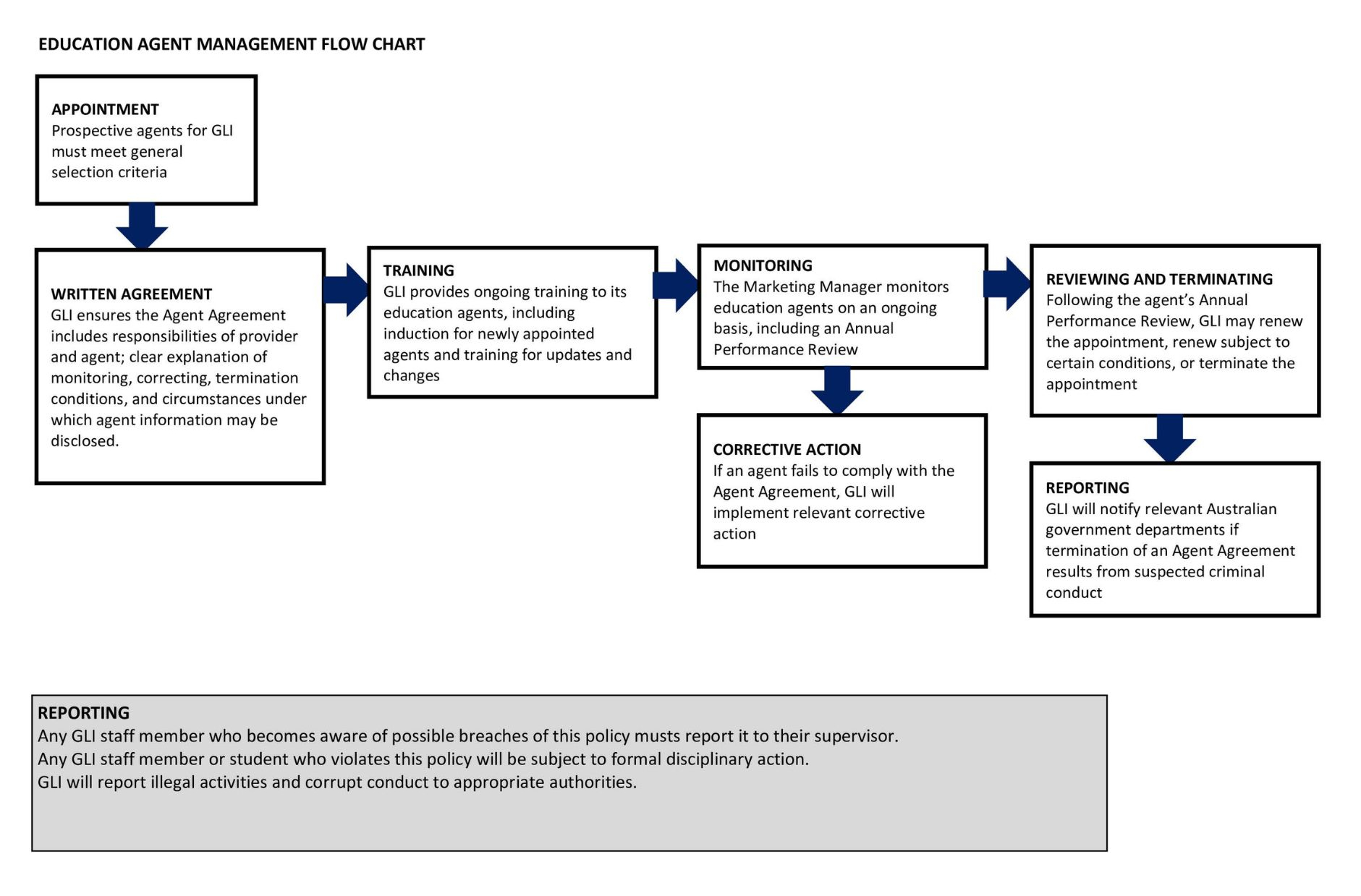
APPOINTMENT
Prospective education agents for GLI must meet the following criteria:
- appropriate knowledge and understanding of the international education system in Australia, including the ESOS Act, National Code, Australian International Education and Training Agent Code of Ethics;
- track record of recruitment and marketing activities with honesty and integrity;
- experience in recruitment of genuine students for Australian higher education institutes;
- appropriate training regarding acting as an education agent for Australian higher education institutes;
- completed Education Agent Application Form, including two referees from Australian higher education institutes, a certified copy of their business registration or license, and details of proposed fees and charges (if applicable).
WRITTEN AGREEMENT
GLI ensures that the written Agent Agreement includes:
- responsibilities of the registered provider, including compliance with the ESOS Act and National Code 2018
- responsibilities of the agent in representing GLI;
- clear explanations regarding monitoring and correcting;
- termination conditions immediate upon failure to meet the National Code 2018 or Migration Act 1958;
- circumstances under which information about the education agent may be disclosed.
TRAINING
GLI provides ongoing training to its education agents, including:
- induction for newly appointed education agents;
- information updates and training when there are changes to legislative and/or regulatory requirements, GLI policies, and/or course changes, including fee structures; and corrective training to address any shortcomings in the education agent’s performance identified through GLI monitoring;
- regular contact with education agents by phone, email, newsletters, and visits to education agents’ offices to provide up-to-date and accurate information on courses and marketing materials to enable them to conduct their business;
- encouragement for education agents to undertake online PIER training to familiarise themselves with relevant legislative and regulatory requirements. Where possible, education agents will be invited to visit GLI for familiarisation.
MONITORING PROCEDURES
GLI’s Marketing Manager monitors education agents on an ongoing basis which includes but is not limited to:
- collection, collation, and analysis of relevant statistical data, including: offer to conversion rates; student visa refusal rates; adherence to GLI admission processes; performance and progression of students through the course; and other relevant data from PRISMS;
- ensuring that education agents below the 75% visa-grant benchmark for two consecutive student intakes enter “corrective action” with mandatory re-training. Chronic under-performance triggers contract termination;
- GLI staff spot checks through face-to-face visits to education agents or contact via phone, email, or other means;
- student surveys;
- student or prospective student feedback/complaints (formal/informal) including claims of engaging in misleading conduct;
- regularly reviewing the education agent’s website for accuracy and currency of information relating to GLI;
- feedback from a relevant Australian government departments;
- Annual Performance Review of education agents to ensure they are meeting agreed Key Performance Indicators and complying with all legislative requirements.
GLI determine from time to time whether, and if so, what, corrective action to implement if an education agent fails to comply with the Agent Agreement. The Institute will take immediate corrective action if it becomes aware, or has reason to believe, that the education agent has not:
- declared and taken reasonable steps to avoid conflicts of interests;
- observed confidentiality and transparency in its dealings with overseas students or prospective students;
- acted honestly and in good faith and in the best interests of the student;
- demonstrated an appropriate understanding of the international education system in Australia, including the Agent Code of Ethics.
CORRECTIVE ACTION
Depending on the circumstances, corrective action may include providing the education agent with additional information, clarifying GLI’s expectations, additional or target training on expectations of the education agent, counselling, written warning(s), or termination of the Agent Agreement.
Where GLI becomes aware of an education agent behaving in an unethical and/or non-compliant manner as indicated in the Agent Agreement, GLI will terminate the agreement.
RENEWING AND TERMINATING
Following the education agent’s Annual Performance Review, GLI may:
- renew the appointment;
- renew the appointment subject to certain conditions, such as a requirement for further training or an improvement in referral, conversion, and success rates;
- terminate the appointment.
The Institute will immediately terminate an Agent Agreement in writing if:
- GLI becomes aware of, or reasonably suspects negligent, careless, incompetent, unethical, or dishonest recruitment practices, including engaging in false or misleading practices, and a deliberate attempt to recruit a student where this clearly conflicts with the obligations of registered providers under the ESOS Act and the National Code;
- a visa application for a student referred by the education agent is refused by the Department of Home Affairs for reasons related to fraudulence or suspicion of fraud;
- GLI becomes aware of any of the other dishonest or criminal practices committed by the education agent;
- the education agent breaches the Agent Agreement;
- GLI is directed or required to terminate the arrangement by a relevant Australian government department.
If the Marketing Manager or delegated authority decides to terminate an education agent’s appointment, the Marketing Manager will:]
- write to the education agent to advise that their appointment has been terminated using the agent termination letter;
- advise staff that no further applications are to be accepted from the agent.
REPORTING
Any GLI staff member who becomes aware of possible breaches of this policy must report it to their supervisor. Any staff member or student who violates this policy will be subject to formal disciplinary action. Penalties may range from restriction from campus or in some more serious instances criminal or civil proceedings. GLI will report illegal activities and corrupt conduct to appropriate authorities.
GLI will notify the relevant Australian government departments of the termination of an Agent Agreement and the grounds for termination if it resulted from suspected criminal conduct. Details relating to the review and decision will be entered on the education agent’s file. The education agent’s name will be removed from the GLI website. The education agent’s students will be notified of the termination/non-renewal and be invited to submit a change of agent request and no further referrals and applications will be accepted from the terminated education agent.