PURPOSE
This policy details Global Leadership Institute (GLI)’s approach to corporate and academic risk management.
SCOPE
Whole Institute
PRINCIPLES
GLI ensures that risk management processes are:
- aligned with GLI’s vision, mission, and values
- the responsibility of all staff, including identifying, assessing, implementing, monitoring, and reporting by staff on an ongoing basis. This includes reporting all incidents, complaints, losses, and near misses involving Institute property, and incidents involving visitors and students, including but not limited to, injuries or potential hazards;
- recorded on GLI’s Risk Register in the case of an incident;
- incorporated into the functioning of Executive Management Team, Governing Board and its standing committees, and Academic Board and its subcommittees;
- incorporated into strategic planning, decision-making, and quality assurance;
- systematically, transparently, and consistently communicated and applied;
- included in staff induction, student orientation, and other relevant ongoing training;
- embedded in the Risk Management Plan in accordance with organisational responsibilities.
DEFINITIONS
Risk: effect (positive or negative) of uncertainty on objectives. Risk is considered with reference to possible consequences and likelihood of occurrence.
Risk Management: tool used to support the achievement of strategic and operational goals of the company. The Risk Management Framework provides a standardised approach to assessing risk at any level of the organisation.
RISK MANAGEMENT PLAN
GLI’s Risk Management Plan provides the formal mechanisms to monitor and review risks that may occur due to the breakdown of internal controls and corporate governance. The Risk Management Plan is reviewed every three years.
SUCCESSION PLANNING
If a key staff member with risk management oversight leaves GLI, the President works with Finance and Budget Committee, Risk Management Committee, and Academic Board to develop a succession plan.
PROCEDURES
Risk ratings are determined through a combination of the consequences for the Institute if the risk is not treated, and the likelihood of this happening. The following Risk Assessment Matrix is utilised:
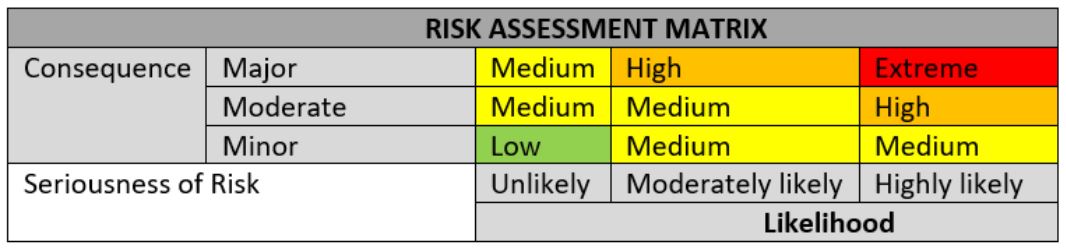
KEY:

RISK MANAGEMENT PROCESSES
The Institute’s risk management strategy detailed in the Risk Management Plan is implemented through the following process:
- establish context;
- identify;
- analyse;
- evaluate;
- treat;
- communicate and consult
- monitor and review.
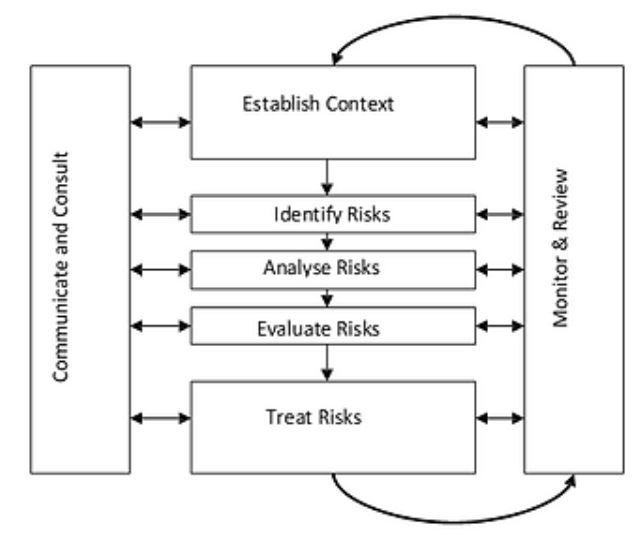
The Risk Management Strategy relevant to each identified risk are recorded in the Risk Management Plan. Risk management processes are also recorded appropriately. Assumptions, methods, data sources, analyses, results, and reasons for decision are also recorded.