PURPOSE
This policy establishes academic performance requirements for Global Leadership Institute (GLI) students and defines criteria for exclusion if students fail to maintain these standards.
SCOPE
All students
PRINCIPLES
GLI maintains high academic standards through:
- Academic Monitoring: Lecturers track performance via formative assessments. Students must engage with Moodle™ and attend scheduled classes prior to the census date.
- Graduate Attributes: The institute supports students in attaining defined Graduate Attributes for their respective courses.
- Progression Requirements: Students must successfully complete at least 50% of enrolled units per semester. Failing the same unit three times constitutes unsatisfactory progress.
- Intervention and Support: the Program Director is responsible for monitoring at-risk students and organising appropriate academic support.
- Sanctions for Non-Compliance: Failure to meet standards may result in conditional enrolment, suspension (up to one year), or exclusion (up to two years). During these periods, the student cannot access GLI premises and resources.
- Fairness: GLI acts fairly when making decisions about student’s performance and academic progress, including providing students with clear and timely information about any unsatisfactory progress and conditions.
- Due Process and Appeals: LI ensures transparent communication regarding academic standing. Affected students retain the right to appeal decisions under the Student Grievance and Appeals Policy.
DEFINITIONS
‘Academic Literacy’ refers to the capacity of a student to undertake formal study and to understand and communicate discipline-specific knowledge.
- Academic Progress Intervention Agreement: support plan designed for an ‘at risk’ student to progress successfully to course completion. The agreement is signed by the student and relevant Program Director.
- Academic Progress Review: compulsory meeting between an ‘at risk’ student and the relevant Program Director to develop an Academic Progress Intervention Agreement.
- At Risk: high likelihood that a student will not meet the requirements for satisfactory academic progress, including not meeting the 80% class attendance, failing the ‘reasonable attempt’ standard for assessment items, and failing to engage with online learning resources.
- Conditional Enrolment: limit on total number of units in which a student may enrol. Students must consult with the Program Director to determine the reduced study load to be carried during the period of Conditional Enrolment.
- Exclusion: if a student fails a unit three times face, enrolment and access to GLI facilities are cancelled for up to 24 months. Re-admission following this period is not guaranteed and requires a formal application for re-admission.
- Satisfactory academic progress: successful completion of at least 50% of the credit points in which they are enrolled.
- Show Cause: a statement by a student that responds to a GLI invitation to explain their unsatisfactory progress and demonstrate why they should not be subject to a period of suspension or exclusion.
- Suspension: student cannot attend class for a specified period. At the conclusion, the student has automatic right of resumption of study in their course. During a period of suspension, a student’s enrolment is terminated, and the student is not entitled to access GLI premises, facilities, or resources.
PROCEDURE
Maximum time to complete a course
Students must meet the completion requirements of a course within a prescribed period from the date of first enrolment to ensure that the qualification awarded reflects currency of knowledge and skill. The maximum time allowed to complete the requirements of a course are listed in the table below. The time elapsed is calculated from the date the student commenced their first term.
| Course | Maximum time to complete |
|---|---|
| Graduate Certificate | 1 year |
| Graduate Diploma | 2 years |
| Master’s Degree | 3 years |
Recording and assessing course progress requirements
GLI monitors the course progress of all students through the development of a Progression and Completion Rates Report by a Program Director which is presented quarterly at the Learning, Teaching and Curriculum Committee and an overview report presented at Academic Board.
Further in consultation with the Academic Dean, the Registrar monitors student course progress and enrolment load to plan unit timetabling, and to ensure international students are meeting their visa requirements.
Where the Program Director identifies that a student is at risk of not completing the course within the maximum time allowed, the Program Director calls an academic advisory session. In that session, the Program Director and student develop a study plan to enable the student to either complete their studies within the prescribed time or complete the course in an extended period.
Where an international student is at risk of failing to meet their visa requirements, the Registrar follows the procedures specified in the Change of Course or Unit Enrolment Policy.
Applications for an extension of time (Domestic and International Students)
Students who fail to complete within the prescribed period or that are at risk of not completing the course within the prescribed time, and who can reasonably be expected to meet the course requirements within two additional terms may apply for an extension of time. Each application is considered on its merit and with reference to the student’s academic performance to date.
Applications for an extension of time to complete the course must be made in writing to the Program Director at least one term prior to the expiry of the student’s prescribed maximum time to complete. The application must include reasons for the student’s inability to complete the qualification in the prescribed period. The Program Director provides a written response to the student within 20 working days outlining their decision and informing the student of their right to appeal the decision.
Students who fail to complete the course requirements within the specified time limit (including any extension of time granted) have their enrolment terminated and a statement noting that ‘the maximum time to complete the course has been exceeded’ appears on the final Record of Results issued to the student. The student is advised in writing of the decision to terminate their enrolment and is also advised that they have 20 working days from receiving notification of the decision to terminate their enrolment to appeal the decision.
Requirement to attain minimum academic standards
The minimum academic standards to be deemed to be maintaining satisfactory academic progress in a course:
- satisfactory performance in formative assessment in units; or/and
- satisfactory academic literacy and English Language proficiency in submitted unit assessments; or/and
- not more than two failures in a unit; or
- not fail 50% or more of the units that make up a course.
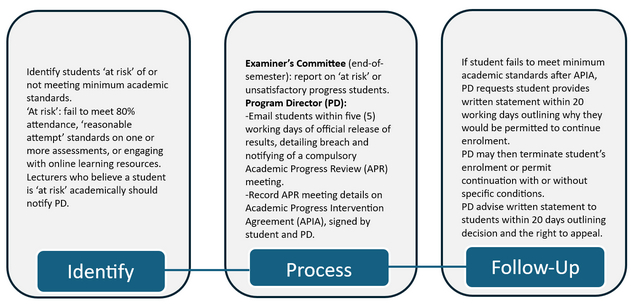
Program Directors monitor the academic performance of each student against the minimum academic standards throughout the term and at the end of each term. Where a student fails to meet the minimum academic standards the Program Director deems that student as being ‘at risk’.
Students are further expected to conduct themselves in their academic studies honestly and ethically and to carefully acknowledge the work of others in all their academic activities. Failure to meet this expectation may constitute academic misconduct under the Student Academic Integrity Policy.
Formative assessments mean of identifying students at risk
Academic performance monitoring is operationalised through formative assessments throughout the course. These assessments to assure the educators that students are appropriately engaged in the units and to gauge whether students are meeting appropriate academic standards.
The first of this formative assessment is usually submitted and marked prior to census date. The remaining formative assessments are spread across the semester to enable continuous monitoring of student engagement.
If after marking a formative assessment an educator believes that a student is at risk academically then they immediately notify the Program Director.
Review process for students deemed to be ‘at risk’
Once the Program Director is notified by a lecturer that a student may be at risk academically, they contact the student and arrange an appointment as soon as possible for an academic advisory session. During the academic advisory session, the Program Director and student determine what additional support is needed and an intervention strategy is put into place. The student is also be advised of the possibility that conditions may be placed on their enrolment if they do not meet academic standards.
International students are also be advised that they may be in contravention of their visa conditions if they do not meet the academic standards.
When advising students at risk, specific consideration is given to First Nations Peoples students to support them to progress and complete their course.
A record of the academic advisory session is signed by the advisor and student and placed on the student’s file.
Students who continue to fail to meet minimum academic standards
f a student continues to fail to meet minimum academic standards after an intervention strategy has been put into place, the Program Director requests that the student provide a written statement within 20 working days outlining reasons why they should be permitted to continue their enrolment in the course. A student who does not submit a written statement by the due date has their enrolment terminated.
The Program Director considers the written statement and may:
- (a) terminate the student’s enrolment; or
- (b) permit the student to continue with or without specific conditions.
The Program Director provides a written statement to the student within 20 working days outlining their decision and informing the student of their right to appeal the decision.
A student who is permitted to continue their enrolment in the course, but with conditions imposed, who again fails to attain the minimum academic standards or breaches the conditions imposed, have their enrolment terminated due to unsatisfactory academic progress.
Consequences of termination of enrolment
A student whose enrolment is terminated due to unsatisfactory academic progress or exceeding the maximum time to complete the course and who wish to undertake further study need to apply to the Institute for re-admission in line with the Student Admission Policy.
Academic Literacy and English Language Proficiency
GLI is responsible for ensuring students are sufficiently competent in the English Language to participate effectively in their studies based on the Student Admissions Policy.
If the Unit Coordinator deems that the outcomes for these formative assessments are unsatisfactory due to poor academic literacy and English language proficiency, the student is identified as ‘at risk’ and referred to the Program Director for a more comprehensive assessment.
Following the assessment, the Program Director initiates an intervention strategy to assist the student to enhance their academic literacy and English Language proficiency skills.
Failing a prerequisite unit
Normal course requirements progression rules require that a student who has not passed a prerequisite for entry to a specific subject cannot be enrolled in that subject. However, where a student believes that this rule adversely affects their course progress, the student may seek a review of this rule by writing to the Program Director. The Program Director assesses the student’s academic and admission records and, if the Program Director believes the student has a capacity to be successful, they may allow the student to repeat the prerequisite unit concurrently with the unit for which it is a prerequisite.
International Students
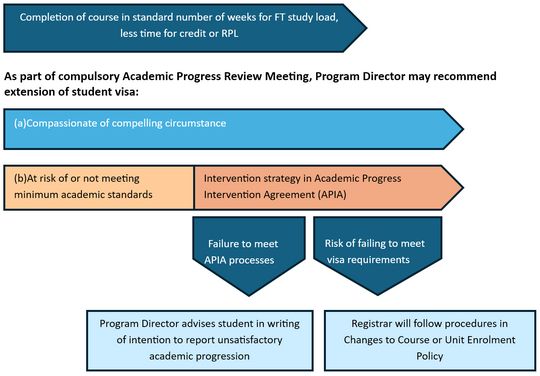
International students are expected to complete their course in the standard number of weeks for a student undertaking a full-time load (the registered CRICOS course duration) less any time for credit granted by the Institute. This period is noted on the student’s CoE and in the Letter of Offer and Student Agreement
Monitoring international student enrolment load and academic progress, follows the procedures outlined above.
In developing and intervention strategy, the Program Director may extend the duration of an international student’s visa where it is clear the student will not complete the course within the expected duration, as specified on the student’s CoE, as the result of:
- (a) Compassionate or compelling circumstances (e.g. illness where a medical certificate states that the student was unable to attend classes); and/or
- (b) An intervention strategy being implemented for students who are at risk or not meeting minimum academic standards.
Where an international student has failed to meet minimum standards, on the advice of the Program Director, the Academic Dean may consider a reduction in their study load as part of an intervention strategy.
Following an intervention strategy being put in place, if an international student fails to meet the minimum academic standards in a second consecutive term, the Program Director advises the student in writing of the intention to report the student for not achieving satisfactory academic progress. The student is advised to seek advice from the Department of Home Affairs on the impact on their student visa if they are reported for failure to meet minimum academic standards. The student is also be advised that they have 20 working days to access the Institute’s grievance handling process.
The student has the right to continue their studies in the course during the period for lodging a grievance or appeal or during its consideration. After all grievance and appeals processes are finalized, or if the student has chosen not to access the grievance handling process within 20 working days, the student’s enrolment is cancelled, and the Institute reports the student through PRISMS.
Typical international student progression:
Review of Decision
A student may request a review of decision if it is inconsistent with this policy. A request for review is made in writing and lodged with the Academic Dean within 10 working days of the student receiving written notification of the decision. The Academic Dean responds in writing to the request within 20 working days and may confirm or vary the decision.
If a student remains dissatisfied with the outcome of their request for a review, they may utilise the Institute’s Student Grievance and Appeals Policy.